Introduction
Over the last few years since the creation of Steve’s Open Lab, equipment in the lab has steadily grown. Much of the focus has been on spectroscopic instrumentation, although there have also been other projects of interest in such areas as magnetometry, with homebuilt gadgets and devices to monitor solar activity with the Arduino and Raspberry Pi computers. My first love, though, is with spectroscopy, whether it is a sophisticated commercial spectrometer, a lower cost hand-held device, or a complete DIY spectrometer build constructed from separate optical components.
The lab is now fairly well equipped for spectroscopic investigations and studies of different materials and samples, as far as can reasonably be achieved by any hobbyist laboratory. There is a dual-beam scanning UV-Visible spectrometer, a Fourier transform infrared spectrometer, a Raman probe with a 532 nm laser excitation source, two 1/8m spectrographs with interchangeable gratings and slits, and a couple of microscopes. Plus all the usual lab glassware and typical lab accessories. What I felt was missing, however, was a good quality fluorescence spectrometer. Being able to perform fluorescence measurements with a professional instrument opens up a fascinating world of fluorescent molecules. There are many examples in areas of environmental and food science, in general organic chemistry and in healthcare and biomolecules that than be examined.
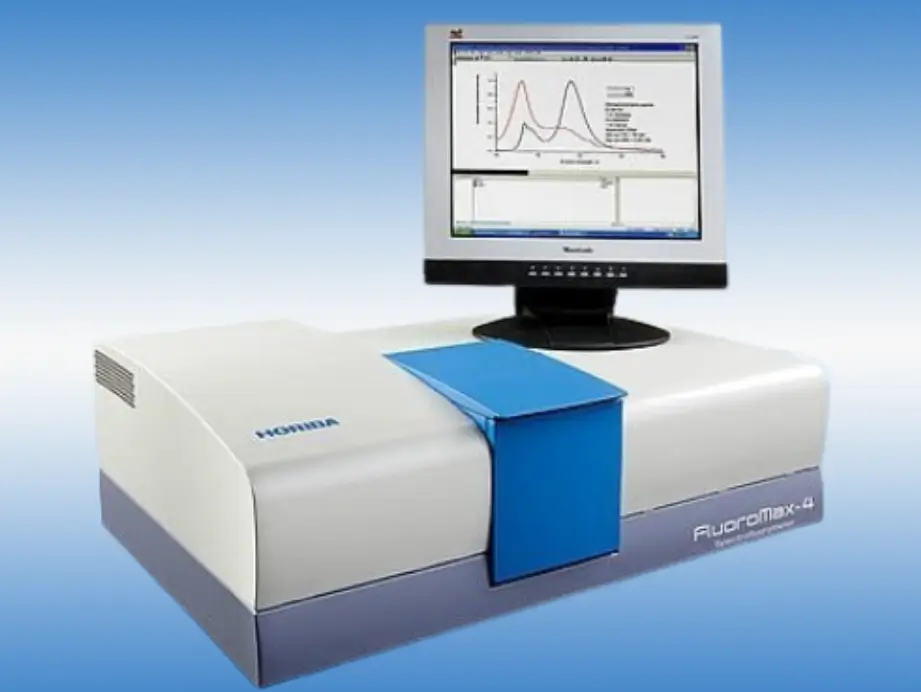
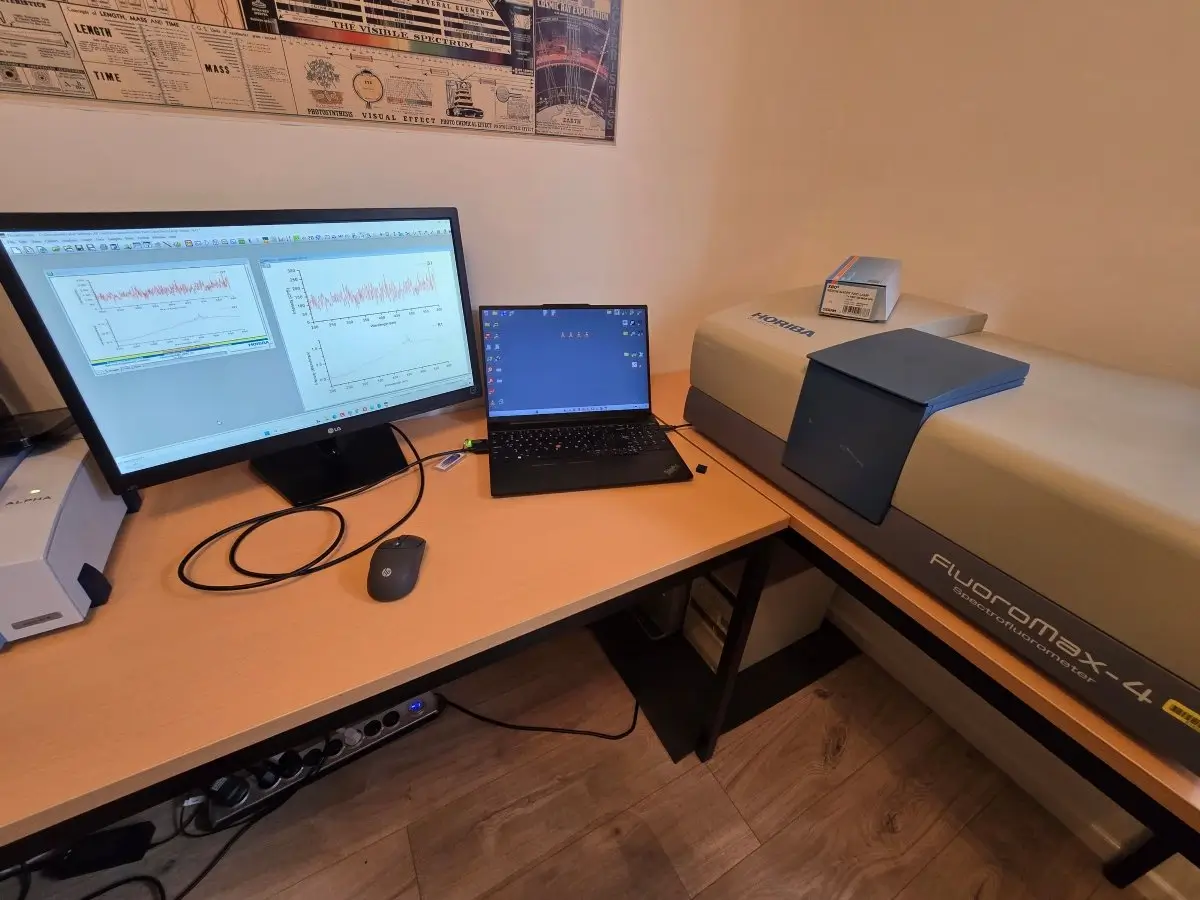
This article briefly recounts how I was able to acquire one such commercial instrument during the summer: a Horiba FluoroMax-4® scanning spectrofluorometer.
An Opportunity Not To Be Missed
Large companies with substantial R&D departments and budgets sometimes renew lab equipment periodically as instrument manufacturers upgrade their hardware, software and introduce the very latest models. Companies that generally do this are the big, global pharmaceutical companies needing the latest technology to develop new medecines and treatments and to remain competitive. But there are also large public institutions such as government environmental testing laboratories that also require a large array of analytical laboratory instruments for the testing and compliance of food, water and environmental samples. If the company or institution no longer requires an instrument, it is often sold on in a secondary market.
Laboratory closures are another source of such second-hand equipment. Large pharma companies, for example, sometimes undergo restructuring and consolidation of their operations to create fewer manufacturing and R&D sites, to return to their core business pipelines, and to cut costs. These decisions can result in lab closures on sites that are no longer strategically required and the lab equipment at these sites – perfectly good equipment – is offered up for sale.
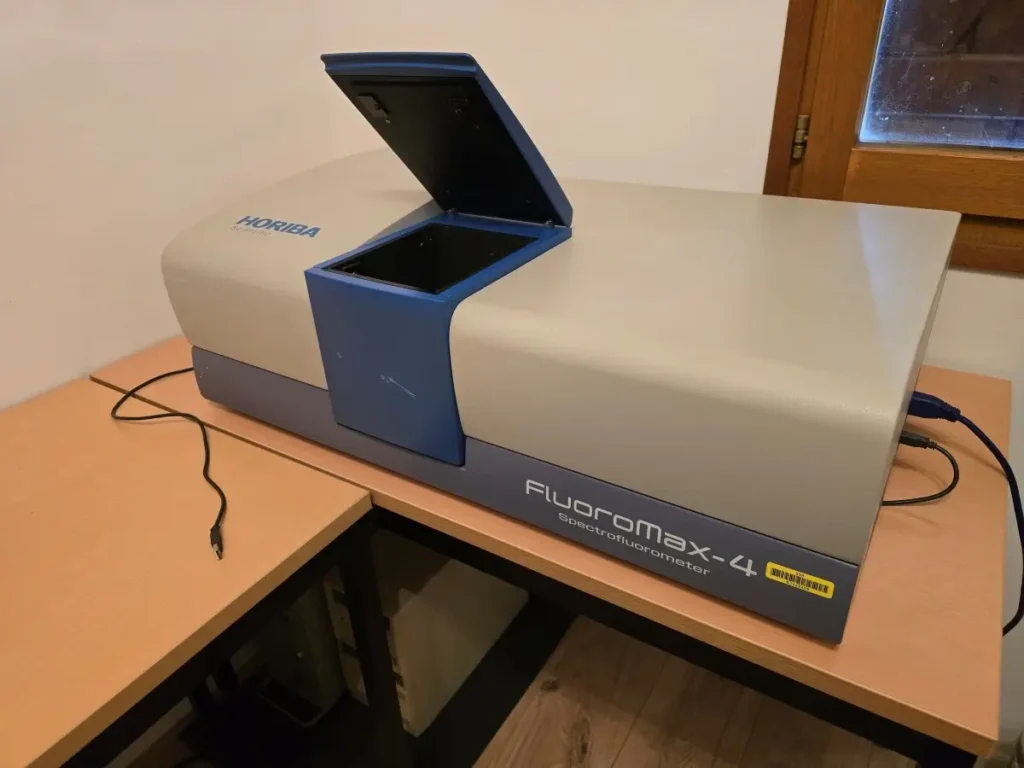
Earlier this year I came across such an opportunity. An online search that I had been running occasionally for the previous few months discovered a Horiba FluoroMax-4® spectrofluorometer for sale in France at an unbelievably low price. I contacted the seller and enquired about the pedigree and history of the instrument, which from the online photos showed it to be in excellent condition. I was told that the spectrometer did indeed come from a laboratory closure, that it powers on correctly, all cooling fans worked fine and the xenon UV arc lamp ignited and functioned as expected. I decided to take the plunge and I bought the instrument.
The FluoroMax-4® arrived within a few days, delivered on a heavy wooden pallet and very well protected with innumerable layers of bubble wrap. This spectrometer weighs over 30 kilograms. It is an exceptionally robust, industrial-grade instrument and is very solidly built. Because it is designed to maintain optical alignment at the micrometer scale over a long operational lifetime, Horiba built it on a heavy, rigid structural foundation. Its heavy weight acts as an excellent dampening mechanism against benchtop micro-vibrations from other lab equipment, that could otherwise interfere with the acquisition of spectra over long integration scans. The instrument is not small, measuring around 32 × 10.5 × 18.5 inches (81 × 27 × 47 cm). So a substantial table or bench had to be found in my lab to site it. The outer casing consists of thick, impact-resistant industrial plastic mouldings covering a heavy inner metal framework. All in all, the FluoroMax® is an exceptionally robust, rugged, and reliable benchtop spectrofluorometer. Academic and industry reviewers in the scientific community highlight its structural longevity and dependable performance.
The Next Steps
Now I already knew that the spectrometer I purchased did not come with any control software. All that was delivered to me was the instrument itself, a power cord and a USB cable for connection to a PC. Fortunately, there was also the all-important Horiba USB security key. If this had been absent, I would not have purchased the instrument. This key acts as a physical security license and copy protection mechanism for Horiba’s FluorEssence™ software that controls the spectrometer. So I now possessed all the critical pieces that would allow me to get the spectrometer up and running, except for the actual software that would control it!
I therefore approached Horiba in France, enquiring as to the possibility of purchasing a copy of the software. I explained how I had come by this specific model of the FluoroMax-4®, adding that I did not represent any commercial entity nor academic institution. I went on to explain that I was simply a retired R&D chemist, still passionate about chemistry and spectroscopy, and who maintained a website and blog providing spectroscopy demonstrations to an interested public for purely educational purposes.
The folks at Horiba responded very favourably and kindly to me. After a few email messages and a video-conference, they very kindly offered me the software free of charge! This gesture was extremely generous on their part and for which I am eternally grateful. The next step was to agree on how to have the software installed on my laptop computer.
One option was for me to take my FluoroMax® up to the Horiba Europe Research Centre located near Palaiseau just south of Paris. Horiba technicians would then be able to check out the instrument, verify optical alignment and examine the state of the xenon arc lamp, in addition to installing the software. The UV lamp was almost certainly going to need replacing after what may have been many years of storage in a warehouse.
Another option was to wait until a Horiba Customer Service Engineer happened to be in the region and who could stop by at Steve’s Open Lab to install the software.
Several months went by and summer slowly passed. Then in late August Horiba informed me that a field service engineer would be in my region soon and would be able to stop at the Lab and install the FluorEssence™ software required to run the instrument. I of course willingly accepted this most generous offer and a time and date was agreed.
Monsieur Alain Gabez, Customer Service Engineer at Horiba France duly arrived one Friday afternoon, kindly offering up his free time to install the software. Alain and I together spent the next few hours “fighting” Windows 11 during the installation of FluorEssence™. One issue we had, and that did take some time to identify, was with the USB Security Key. The key functioned fine, but it was unable to recognise the software. After several unsuccessful avenues of research, the problem was finally found: an Energy Saver option deep inside Windows 11 Settings was reducing the power to the laptop’s USB ports when not in use. Windows apparently did not recognise the security key as a “normal” drive such as an external storage device and so the Energy Saver setting reduced power to the USB port. Since the security key required power to be on full at all times, it failed to verify the license and allow the software to run. Once this Energy Saver option was permanently disabled in Windows Settings, the FluorEssence software ran perfectly 😊.
Alain kingly gave me a quick tutorial on the software, how to monitor the xenon arc lamp output and record the water Raman peak. These are procedures that need to be done on a regular basis before recording any sample spectra.
I subsequently learned that this particular FluoroMax® originated from an R&D lab closure at Sanofi, the global French pharmaceutical giant. The instrument originally came from Sanofi’s R&D hub at Chilly-Mazarin, which began down-sizing laboratories during the period 2009-2012, with final closure of all labs in 2019-2020.
This particular FluoroMax-4 appears to have been optimized for the red and near infrared (NIR) regions of the spectrum. The photomultiplier tube (PMT) is an R2658P type with an InGaAs photocathode (the P in the name refers to Hamamatsu’s photon counting option). This provides increased sensitivity out to about 1040 nm. The usual PMT for a FluoroMax® is the R928P type from Hamamatsu that only extends to about 900 nm. But both PMTs possess excellent sensitivity down to 200 nm in the UV.
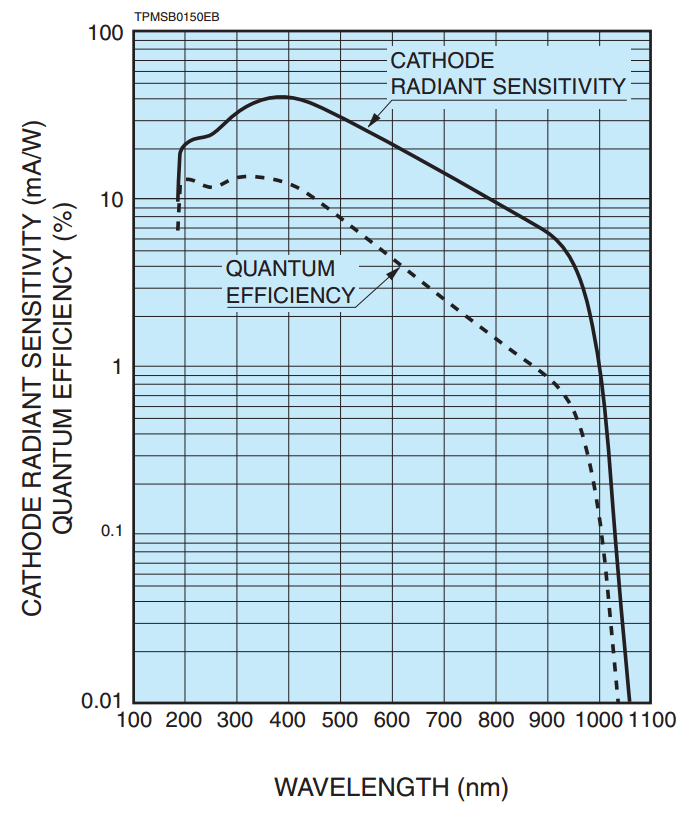
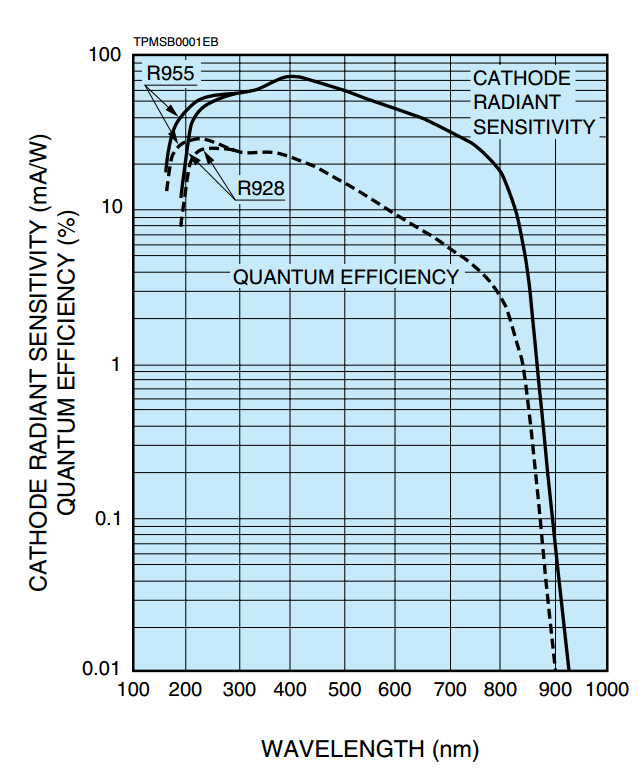
In addition, the blaze angles for both gratings have been manufactured so that optimum diffraction efficiency falls around 500 nm (for the excitation monochromator) and 750 nm (for the emission monochromator). This does not mean that the monochromators cannot operate in the blue and UV; it only means that grating efficiency and the number of dispersed photons will be lower in these regions. Larger slit bandpasses and/or longer integration scan times will compensate for this. But clearly, this particular FluoroMax-4® has a configuration optimized for deep red and NIR spectral studies.
In conclusion, the lab now has a fully functional fluorescence spectrometer! Together with the other equipment mentioned earlier, Steve’s Open Lab is now very well equipped to perform educational lab demonstrations and investigations in molecular spectroscopy with an excellent range of analytical instruments.
Acknowledgments & Thanks
My most sincere thanks first of all goes to Monsieur Alain Gabez, Customer Service Engineer at Horiba France SAS, for taking time out of his very busy schedule assisting actual commercial customers, and for spending several hours with me to get the software installed correctly and the FluoroMax up and running.
My deep appreciation and thanks are also due to Régis Decraemer, Service Product Manager at Horiba, to Camille Bertaux, E-Commerce Project Manager and to Fabrizio Poli for setting up a Microsoft Teams meeting that allowed me to introduce myself to the Horiba team and to explain the online educational projects I am involved in at my home lab. No doubt they took pity on me as someone with a perfectly good fluorescence spectrometer in his possession, but without any means to operate it! 😁 I am deeply grateful to all of them for their kindness, support and suggestions that brought this project to a successful conclusion.