Spectrum tubes are a very useful way to introduce science students to the study of the interaction of light photons with matter and the subject of optical spectroscopy. They are often seen in demonstrations in high schools and early university lab classes to teach the basic principles of quantum theory and atomic and molecular transitions.
Picture of a typical spectrum tube
A typical spectrum tube, such as the one shown in the image above, usually contains a gas, such as hydrogen, neon, mercury vapour, etc. at very low pressure, that will produce narrow atomic emission lines when an electric current is passed through it. The glass or quartz tubes are prepared under vacuum and a small quantity of the sample gas, whose spectrum is to be studied, is bled into the tube, during manufacture, to a pressure of about 5-20 torr.
Typically, the tubes are 20-30 cm long with a middle “capillary” section used to observing the spectral lines. Metal contacts are attached at each end of the tube during manufacture and the tube is typically inserted into a power supply between spring-loaded electrodes. The following two pictures depict the high voltage power supply that is needed to produce the discharge.
Picture of power supply with unlit tube
Neon Emission Spectrum Tube Lit Up
The voltage needed to generate the discharge in these tubes is typically around 1000-1500V with a current of about 10mA. This high voltage, the value of which depends on the actual gas pressure in the tube, will then exceed the breakdown voltage of the gas. As a result, current then flows and completes the electrical circuit. Thus the tube lights up and produces atomic or molecular emission lines and bands characteristic of the atomic or molecular species under study.
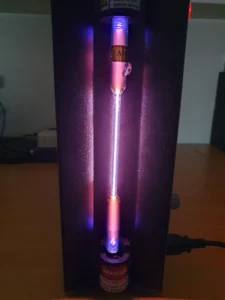
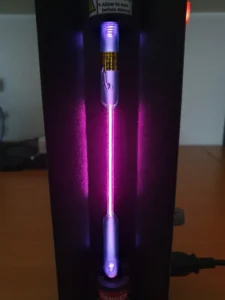
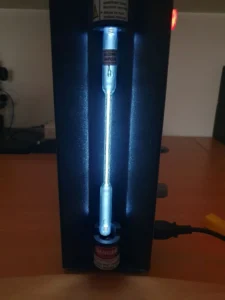
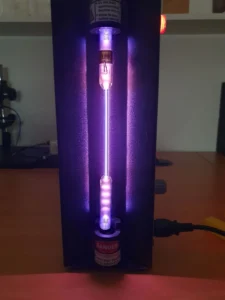
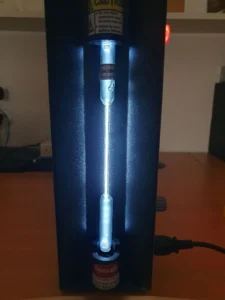
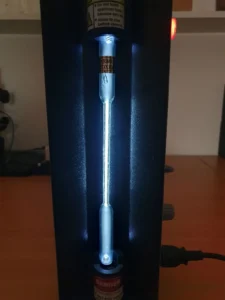
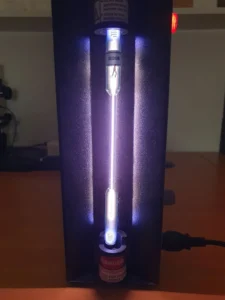
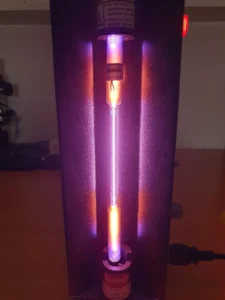
A Rainbow of Colours
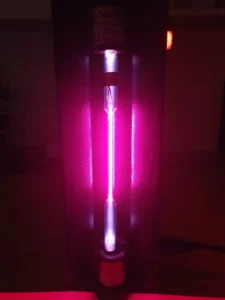
colours of spectrum tubes
Hydrogen
Hydrogen discharge tube emitting strongly in the red from the H-alpha Balmer line at 636.5 nm
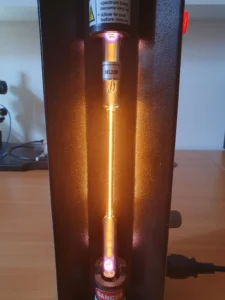
Helium
Helium discharge tube showing its characteristic strong emission in the yellow region
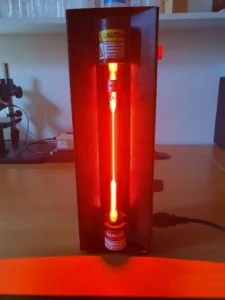
Neon
Neon glow discharge at low pressure showing the characteristic red colour due to multiple red emission lines
Argon
Argon discharge with a mix of red and blue emission lines
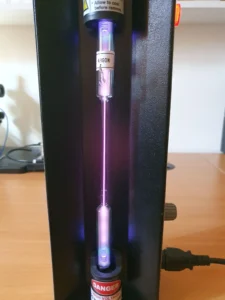
Krypton
Krypton discharge showing the blue/violet emission lines dominating.
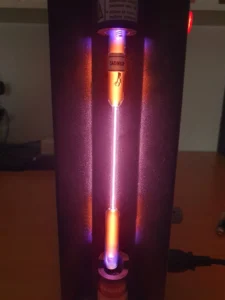
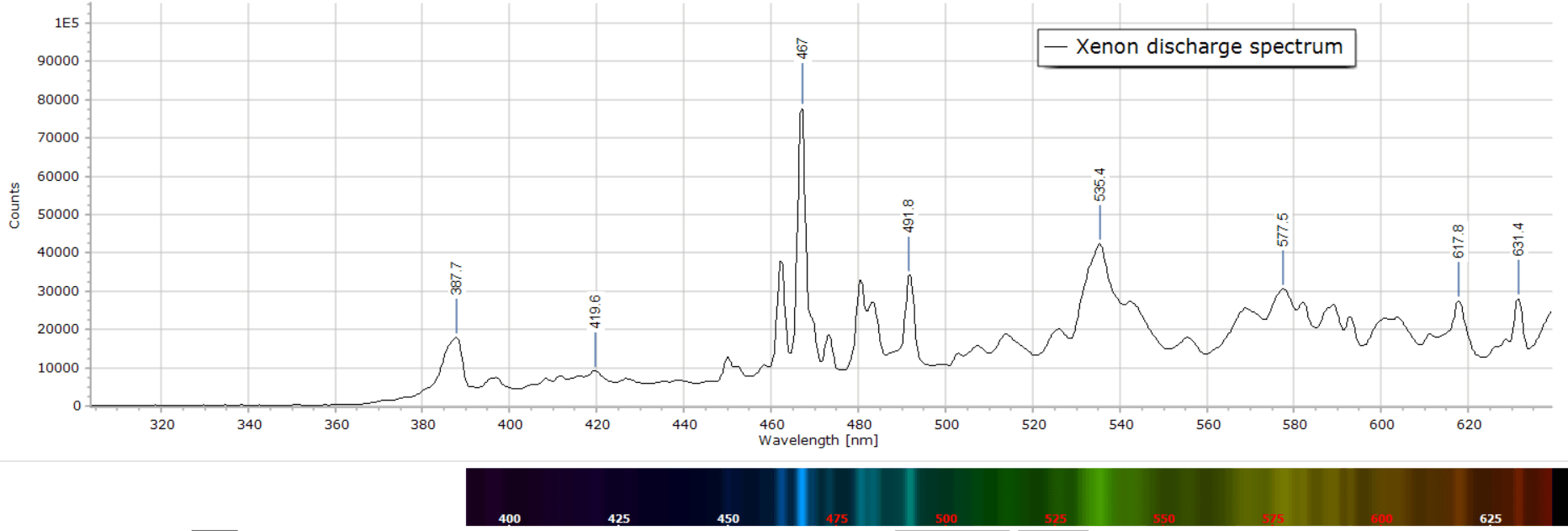
Xenon
Xenon gas discharge
Mercury Vapour
Emission here shows the 546 nm and 576-579 nm doublet emission lies as well as lines at 434 and 404 nm characteristic of Hg.
Nitrogen
A fairly weak emitter in the visible, with most transitions in the UV. (The nitrogen laser emits at 337 nm.)
Air
The glow discharge in air
Water Vapour
Presents a strong H-α emission line at 656.3 nm.
Alcohol Vapour
Complex spectrum with emission bands from radicals (CH, OH, C2)
Sulphur Vapour
Chlorine
Strong Hα line (contaminant) plus several band heads
Carbon Dioxide
Band heads from C2 and other radical species
Sodium
Sodium D line at 589 nm with red bands showing some coarse vibrational structure
Ammonia
Complex spectrum with some band of coarse vibrational structure. Possible contaminant gas(es) giving rise to other radical emission bands
Cadmium
Very similar to the ammonia tube. Likely due to several contaminant gas(es) producing diatomic radicals. Complex spectrum.
Experimental Setup
The spectra in the next section were all obtained by placing one end of a 600 μm optical fibre close to each emission tube with the other end, via a small collimator lens, focused onto the entrance slit (25μm) of an Oriel-Newport MS125 spectrometer. Spectra were recorded with either a 600 lpm or 1200 lpm grating.
Depending on tube intensity, data acquisition times varied from 50 to 1500 accumulations of 1 millisecond exposures with an Andor iDus 420 CCD detector thermoelectrically cooled to -60C below ambient. Similar compact optical fibre spectrometers and configuration settings can produce similar resluts.
Steve’s Open Lab documents instrument development, independent lab investigations and practical scientific demonstrations. Some articles describe complete experiments, while others record progress in longer-term research projects as new observations become available. Whether you’re looking for a quick experiment or following an ongoing investigation, I hope you’ll find something here that sparks your own curiosity.
Hi,
Several reasons. The pressures are relatively low to allow the applied voltages across the electrodes of the tube to be fairly low, typically 1000 to 1500 Volt which is “low’ for this application. This voltage then ionizes the atoms/molecules of the gas to form ions, excited atomic and molecular species, and allows a current to flow. The excited atomic or molecular species are produced from collisions with electrons and atoms, but then release their excess energy in the form of light at wavelengths that are characteristic of the gas.
A second reason for low pressures is that the emission lines will be narrow and not subject to pressure broadening. Various mechanisms that broaden spectral lines are covered in this blog post https://stevesopenlab.org/emission-spectra-of-the-noble-gases/ This is important when the line emission wavelengths are used to calibrate spectrometers, such a spectrum tubes for Mercury and the noble gases Neon, Krypton, etc.
Possibly a minor(economic) advantage is that this reduces the cost per tube by the manufacturer since they are using less gas. but that is a very minor reason.
Hope this helps.
Any questions, feel free.
Thanks for the comment,
Steve
steve, how heavy is the entire setup? Could the specctrum tube filled with say helium, and emitting light be passed over the body or is the set up heavy? WOuld the helium light up yellow and how long could it stay lit. Does it detrioriate with use over time. How long would it last under frequent use. Do you sell these?
Hello Alice,
I don’t sell these tubes myself. They were obtained from an Indian supplier, together with the power supply. The supply itself weighs a couple of pounds, so around 1 kg, and is a bit temperamental. As you certainly know, these types of tube are intended for lab bench demonstrations of spectral lines and as an introduction to spectroscopy in high schools and colleges.
With a helium tube you have the strong atomic He line at 587 nm in the yellow and this would be visible when passed over the body. The setup you see in the article is meant for the lab bench. The tubes are held between springs that also act as the electrodes that initiate the discharge. With some tubes this contact with the springs is sometimes a bit loose. So if you wanted to pass the whole setup over the body by hand, you will need a means of ensuring that the tube does not fall out.
If you are based in the US or the UK, there are other suppliers of tubes and power supplies that are more expensive. An example is Arbor Scientific https://www.arborsci.com/products/spectrum-tube-power-supply But I would ask them if the supply + tube can be “scanned” over the body first. Remember though that this is not their primary function.
As for lifetime, it varies from tube to tube. The more common ones such as neon and mercury tend to be the most reliable. One or two I’ve had in the past did not even light up. The He tube I have does seem to be fairly reliable.
What is your application? I may be able to guide you. Remember that these tubes are meant for lab class demonstrations. As such, they are typically lit up for only a couple of minutes to show the spectral lines.





















4 thoughts on “Spectrum Tubes”
What purpose does the low pressure of the gas serve in these tubes?
Hi,
Several reasons. The pressures are relatively low to allow the applied voltages across the electrodes of the tube to be fairly low, typically 1000 to 1500 Volt which is “low’ for this application. This voltage then ionizes the atoms/molecules of the gas to form ions, excited atomic and molecular species, and allows a current to flow. The excited atomic or molecular species are produced from collisions with electrons and atoms, but then release their excess energy in the form of light at wavelengths that are characteristic of the gas.
A second reason for low pressures is that the emission lines will be narrow and not subject to pressure broadening. Various mechanisms that broaden spectral lines are covered in this blog post https://stevesopenlab.org/emission-spectra-of-the-noble-gases/ This is important when the line emission wavelengths are used to calibrate spectrometers, such a spectrum tubes for Mercury and the noble gases Neon, Krypton, etc.
Possibly a minor(economic) advantage is that this reduces the cost per tube by the manufacturer since they are using less gas. but that is a very minor reason.
Hope this helps.
Any questions, feel free.
Thanks for the comment,
Steve
steve, how heavy is the entire setup? Could the specctrum tube filled with say helium, and emitting light be passed over the body or is the set up heavy? WOuld the helium light up yellow and how long could it stay lit. Does it detrioriate with use over time. How long would it last under frequent use. Do you sell these?
Hello Alice,
I don’t sell these tubes myself. They were obtained from an Indian supplier, together with the power supply. The supply itself weighs a couple of pounds, so around 1 kg, and is a bit temperamental. As you certainly know, these types of tube are intended for lab bench demonstrations of spectral lines and as an introduction to spectroscopy in high schools and colleges.
With a helium tube you have the strong atomic He line at 587 nm in the yellow and this would be visible when passed over the body. The setup you see in the article is meant for the lab bench. The tubes are held between springs that also act as the electrodes that initiate the discharge. With some tubes this contact with the springs is sometimes a bit loose. So if you wanted to pass the whole setup over the body by hand, you will need a means of ensuring that the tube does not fall out.
If you are based in the US or the UK, there are other suppliers of tubes and power supplies that are more expensive. An example is Arbor Scientific https://www.arborsci.com/products/spectrum-tube-power-supply But I would ask them if the supply + tube can be “scanned” over the body first. Remember though that this is not their primary function.
As for lifetime, it varies from tube to tube. The more common ones such as neon and mercury tend to be the most reliable. One or two I’ve had in the past did not even light up. The He tube I have does seem to be fairly reliable.
What is your application? I may be able to guide you. Remember that these tubes are meant for lab class demonstrations. As such, they are typically lit up for only a couple of minutes to show the spectral lines.
Kind regards
Steve